
He Begged the World to Help. The World Said No. 800,000 People Died.
I don't give five stars often. I mean it. Most books are good. Some are great. Very few stop you in your tracks and make you question the world you live in.
This one did all three.
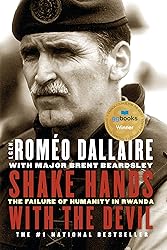
Roméo Dallaire was a Canadian general. He went to Rwanda in 1993 as the commander of a United Nations peacekeeping mission. His job was to help keep the peace during a tense political period. He had soldiers, a mandate, and a chain of command. What he didn't have was real power. Or enough men. Or anyone in the world willing to listen when he screamed for help.
What followed was 100 days of horror that the world chose not to stop.
Over 800,000 people — mostly Tutsi civilians — were killed between April and July 1994. Not in a battlefield. In churches. In schools. In their homes. Neighbors killed neighbors. People who had lived side by side their whole lives turned on each other with machetes. And Dallaire stood in the middle of it with a small force and no authorization to stop what he was seeing.
Sounds impossible, right? That anyone could watch this and not act?
But that's what happened. Dallaire sent fax after fax to the UN. He warned them. He told them exactly what was coming before it started. He had intelligence. He had a plan to stop it. And the UN told him to stand down. The US, still stung by Somalia, refused to call it genocide. France had its own interests. The major powers looked away.
And people kept dying.
What makes this book unlike anything else I've read is Dallaire's honesty. He doesn't protect himself. He tells you about the deals he made with killers — shaking the hand of men he knew were ordering the slaughter — because he thought it might buy time or save a few more lives. And he asks himself, on every page, whether any of it made a difference.
He carried PTSD back to Canada with him. Severe, crushing, career-ending PTSD. He struggled with alcohol. He attempted suicide. His marriage took enormous strain. All of this is in the book. No filter. No clean ending.
He writes about a moment on a bridge in Kigali — surrounded by bodies — where he wanted to give up. Where the weight of it all broke something in him that never fully healed. And he kept going anyway. Not because he had hope. But because the people around him still needed someone to stay.
Can you imagine carrying that? Watching children die and knowing your government has the power to stop it and simply won't?
This book is hard. Some sections are almost too heavy to read. You have to put it down and breathe. But I think that discomfort is the point. Rwanda wasn't supposed to happen. The world had already said "never again" after the Holocaust. And then it happened again. On live television. While the international community held meetings.
Dallaire doesn't let anyone off the hook. Not the UN. Not the US. Not France. Not Canada. And not himself.
The title comes from a painful truth. To try to stop a genocide with limited resources, Dallaire had to sit across tables from the men engineering the killing. He shook their hands. He talked to them. He tried to find angles and pressure points. And he calls that — meeting pure evil face to face and doing it anyway — shaking hands with the devil.
There is a 2007 film version as well, starring Roy Dupuis. It's worth watching. But read the book first. The film can show you what happened. Only the book can show you what it felt like from the inside.
Five stars. No hesitation. If you read one book this year about what it means to fail as a global community — and what it looks like when one man refuses to abandon his humanity in the middle of that failure — make it this one.
This book should be required reading. Not for history classes. For all of us.
Comments
Post a Comment